
How to Properly Pack and Secure a Differential Carrier for Shipping
Differential carriers are heavy, awkwardly shaped, and expensive to replace when they arrive damaged. When sending a unit to Heavy Duty Transaxle for service, proper packaging is the single biggest factor in whether your freight arrives intact. LTL carriers handle thousands of pallets a day, and a poorly secured differential carrier almost always loses that fight.
Below is the packaging procedure we use and recommend at HDT for every differential carrier assembly that leaves our facility. Following these steps will protect your shipment, reduce the risk of damage claims, and keep your freight moving without delays.
The Short Version in Five Steps
- Ensure the pallet is in good structural condition and can hold strapping tight.
- Visually verify that no part of the carrier assembly overhangs the pallet. Anything overhanging is at risk of damage during transport.
- Position carrier on the pallet as close to the center as possible to ensure stability.
- Strap the carrier assembly down. Use two straps at a minimum and ensure there are no twists so the carrier cannot shift. Use blocks of wood as needed to stabilize.
- Fully wrap the carrier assembly in heat shrink or stretch wrap to keep foreign debris out.
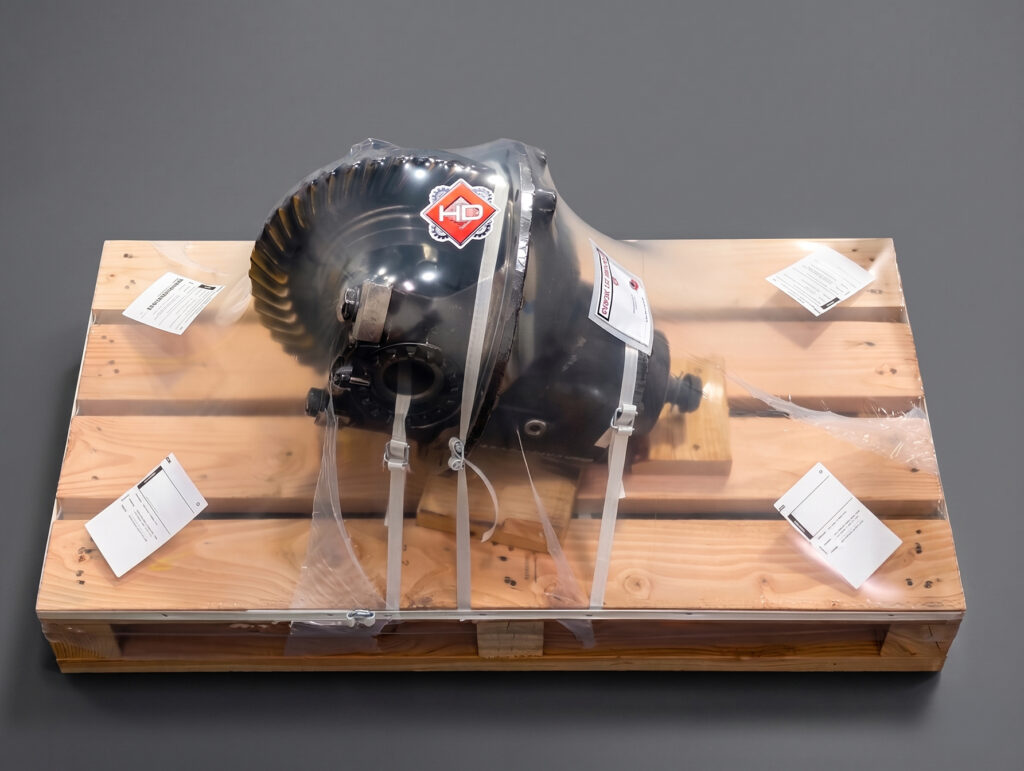
Start With a Sound Pallet
Before you place anything on a pallet, inspect it. The pallet needs to be in solid structural condition with no cracked stringers, broken deck boards, or protruding nails. A weak pallet will not hold strapping under tension, and once a strap loosens in transit, the load shifts. A shifting differential carrier on a moving trailer is how cracked housings, bent yokes, and damaged ring and pinion gears happen.
If you have any doubt about the pallet, replace it. The cost of a new pallet is a fraction of the cost of a damaged carrier or a freight claim.
Strap the Carrier Down — At Least Two Straps
Use a minimum of two straps to secure the differential carrier to the pallet. Run the straps over the heaviest, most stable points of the assembly and pull them tight. Check that there are no twists in the strapping, since a twisted strap loses tension and creates a weak point. Once strapped, give the carrier a firm push from several angles to confirm it does not shift on the pallet.
For carriers with irregular geometry, use blocks of wood as bracing to stabilize the load before strapping. Wood blocks wedged against the housing or under unsupported sections prevent the carrier from rocking and keep the straps engaged with the load.
Position the Carrier for Stability
Place the differential carrier as close to the center of the pallet as possible. Centering the load distributes weight evenly, keeps the pallet balanced when forklifted, and prevents tipping during handling. A carrier sitting off-center on a pallet will lean, pull on the strapping unevenly, and is far more likely to shift in transit.
Just as importantly, no part of the carrier assembly should overhang the edge of the pallet. Anything hanging over — an input yoke, a mounting flange, a brake spider, a bearing cap — is exposed and at high risk of being struck by another pallet, a forklift tine, or a dock door during handling. Overhanging components are the single most common cause of carrier damage in LTL freight, and they’re entirely preventable.
If the carrier is shorter than the pallet footprint, that’s fine — extra deck space doesn’t hurt anything. But if the carrier is larger than the pallet, don’t force it. Move up to a larger pallet rather than letting any part of the assembly hang past the edge.
Wrap the Entire Assembly
Once the carrier is strapped and stable, fully wrap the entire assembly in heat shrink or stretch wrap. Wrapping serves two purposes: it keeps road dust, rain, and debris off machined surfaces and exposed gear teeth, and it adds a final layer that holds smaller hardware, tags, and paperwork in place. Pay particular attention to fully covering input yokes, ring gear teeth, and any open ports where contamination could enter the housing.
A properly wrapped carrier should look like a single sealed unit, not a parts collection sitting on wood.