
Rockwell Hypoid Planetary Two-Speed Differential Carrier Maintenance Manual
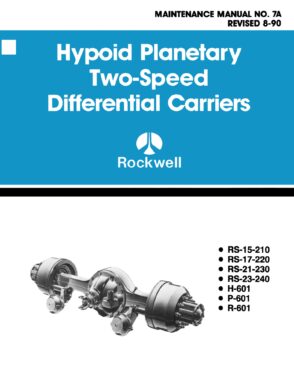
This maintenance manual provides technical instructions for the service and repair of Rockwell Hypoid Planetary Two-Speed Differential Carriers, specifically models RS-160 and RS-180. These carriers utilize a planetary gear set to provide two different axle ratios, controlled by a shift assembly.
1. Key Technical Specifications
Proper operation and assembly depend on adhering to strict adjustment parameters:
- Pinion Bearing Preload: Controlled by a spacer between the bearings. New bearings require 15-25 lb-in (1.7-2.8 N·m) of torque, while used bearings in good condition should be set to 10-20 lb-in (1.1-2.3 N·m).
- Differential Bearing Preload: The standard specification is 15-35 lb-in (1.7-3.9 N·m). It can also be measured by expansion between bearing caps: 0.002-0.009 inch (0.05-0.229 mm) for RS-160 and 0.006-0.013 inch (0.15-0.33 mm) for RS-180.
- Ring Gear Backlash: For gears with a pitch diameter of 17 inches or greater, the range is 0.010-0.020 inch (0.25-0.51 mm), with a nominal setting of 0.015 inch (0.38 mm) for new gear sets.
- Runout and Resistance: Maximum allowable ring gear runout is 0.008 inch (0.20 mm). The maximum rotating resistance for differential gears is 50 lb-ft (68 N·m).
2. Assembly and Service Highlights
- Pinion Depth Adjustment: Controlled by a shim pack between the bearing cage and carrier. Technicians must calculate new shim thickness based on measured old shims and Pinion Cone (PC) variation numbers die-cut on the gears.
- Matched Sets: Drive pinions and ring gears are matched sets and must always be replaced together.
- Ring Gear Installation: Ring gears should be heated in water to 160°F-180°F (71°C-82°C) for 10 to 15 minutes to permit a press-free fit over the case half pilot.
3. Lubrication and Maintenance
- Oil Quality: Use API GL-5 hypoid gear oil. The axle sump temperature must never exceed 250°F (121°C).
- Change Intervals: Intervals vary by vocation; for example, heavy-haul vocations require petroleum-based oil changes every 25,000 miles or annually.