
AxleTech Carrier Box Assembly Maintenance Manual MM5.3
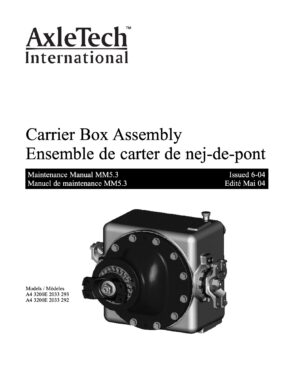
This maintenance manual (MM5.3) provides detailed service and repair procedures for the AxleTech Carrier Box Assembly used in heavy-duty drive axles. The assembly functions as a central housing for internal components like the differential and gearing systems.
1. Technical Adjustments and Specifications
Precise assembly is critical for operational longevity. Key technical requirements include:
- Pinion Bearing Preload: Controlled by the thickness of the spacer between bearings. New bearings should be adjusted to 15–25 lb-in (1.7–2.8 N·m), while used bearings in good condition require 5–25 lb-in (1.7–2.8 N·m).
- Ring Gear Backlash: For gears with a pitch diameter of 17 inches (431.8 mm) or greater, the setting range is 0.010–0.020 inches (0.25–0.51 mm). The nominal setting for a new gear set is 0.015 inches (0.38 mm).
- Ring Gear Runout: The maximum allowable lateral runout is 0.008 inches (0.20 mm).
- Rotating Resistance: The differential gears must have a rotating resistance of no more than 50 lb-ft (68 N·m) of torque applied to one side gear.
2. Assembly and Disassembly Procedures
- Matched Gear Sets: Drive pinions and ring gears are available only as matched sets. Technicians must check the match numbers to verify the gear set parts match before installation.
- Pinion Depth Adjustment: The depth of the pinion in the carrier is controlled by a shim pack located between the bearing cage and carrier. New shim pack thickness must be calculated based on the old pack measurement and the pinion cone (PC) variation numbers on the old and new gears.
- Ring Gear Installation: To prevent damage to the case half, the ring gear should be heated in water to 160°F–180°F (71°C–82°C) for 10–15 minutes, allowing it to fit easily onto the pilot without a press.
- Silicone Gasket Material: Apply a 0.125-inch (3 mm) diameter continuous bead of silicone gasket material (e.g., Loctite® 5699) around the edge of fastener holes on mounting surfaces.